
Physics in 10th grade is a continuation of an exciting journey, where we move from superficial observation to an in-depth analysis of the processes and phenomena that govern the world. At this stage, such fundamental sections as molecular physics, thermodynamics, electrostatics and direct current laws are studied. Now it is not enough to just know the definition – you need to understand how these laws work at the micro and macro levels.
The main feature of 10th grade is the active use of the mathematical apparatus. You will operate with more complex formulas, build graphs and analyze dependencies, which will allow you to look at the usual processes in a new way. We will help you master these tools so you don’t just rememberThey really understood and knew how to apply knowledge. Thus, this course will be a solid foundation for your further education.
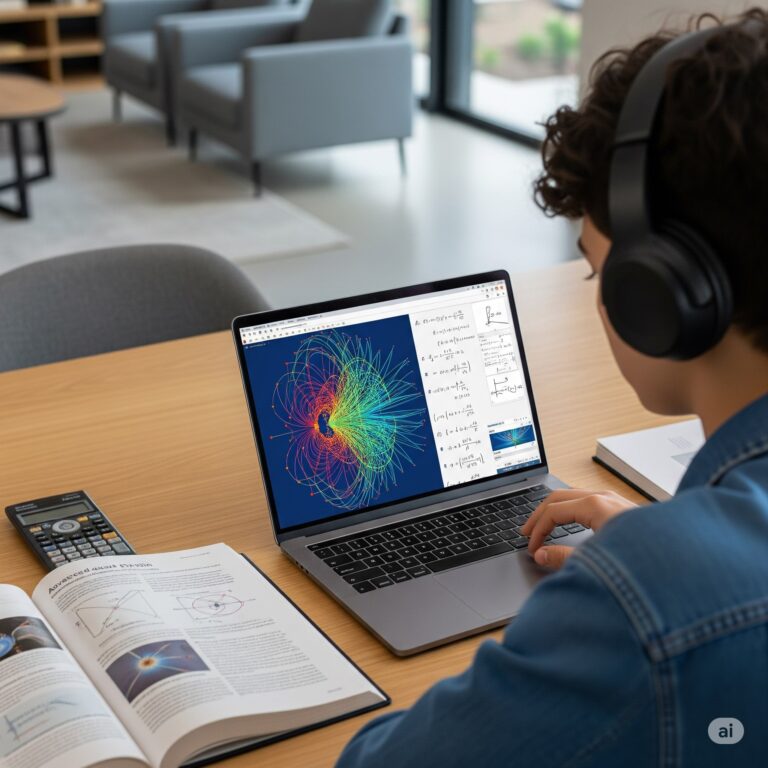
Approximate planning for the 10th grade physics course
Section I. Mechanics Part 1. Kinematics | ||
| 1 | The main task of mechanics. The Kinematics Alphabet | |
| 2 | Speed of movement. Average and Instant Speed | |
| 3 | Laws of addition of movements and speeds | |
| 4 | Uniformly accelerated rectilinear motion. Acceleration | |
| 5 | free fall | |
| 6 | Curvature motion under the action of constant gravity | |
| 7 | Uniform motion of a material point in a circle | |
Section I. Mechanics Part 2. Dynamics | ||
| 8 | Inertial frames of reference. Newton’s first law | |
| 9 | Power. Mass. Newton’s second and third laws | |
| 10 | Gravity field. gravity. The first cosmic speed | |
| 11 | The force of elasticity. Body weight | |
| 12 | Friction force | |
| 13 | Equilibrium of bodies. moment of force | |
| 14 | Mechanical work. Kinetic energy. Power | |
| 15 | Potential energy. Mechanical energy conservation law | |
| 16 | Body momentum. Jet propulsion. Elastic and inelastic collision | |
| 17 | Movement of liquid and gas. The lifting force of the wing | |
Section I. Mechanics Part 3. Mechanical oscillations and waves | ||
| 18 | Types of mechanical oscillations | |
| 19 | Mathematical and spring pendulums. oscillation energy | |
| 20 | Resonance | |
| 21 | Mechanical waves | |
| 22 | Sound waves | |
| Section II. Elements of special relativity | ||
| 23 | Postulates of the theory of relativity. Relativistic law of addition speeds | |
| 24 | Consequences of the postulates of special relativity | |
Section III. Molecular Physics and Thermodynamics Part 1. Molecular Physics | ||
| 25 | The main provisions of molecular kinetic theory | |
| 26 | Movement and interaction of molecules | |
| 27 | The basic equation of the MCT of an ideal gas | |
| 28 | Temperature. Kelvin temperature scale | |
| 29 | The equation of state of an ideal gas. Isoprocesses | |
| 30 | Vapor formation and condensation. Saturated and unsaturated steam. Boiling | |
| 31 | Humidity. Dew point | |
| 32 | Surface tension of the liquid. Wetting. Capillary phenomena | |
| 33 | Structure and properties of solids. Crystal anisotropy. Liquid crystals | |
| 34 | Mechanical properties of solids | |
Section III. Molecular Physics and Thermodynamics Part 2. Fundamentals of Thermodynamics | ||
| 35 | Internal energy. Ways to change internal energy | |
| 36 | Work in thermodynamics | |
| 37 | The first law of thermodynamics. Adiabatic process | |
| 38 | The principle of operation of heat engines. Refrigeration machine | |
| Section IV. Electric field | ||
| 39 | Electric field | |
| 40 | Work on moving the charge in an electrostatic field. Potential | |
| 41 | Conductors and dielectrics in an electric field. | |
| 42 | Electricity. Capacitors. The energy of a charged capacitor | |


 095 917 1785
 095 917 1785
 095 917 1785