
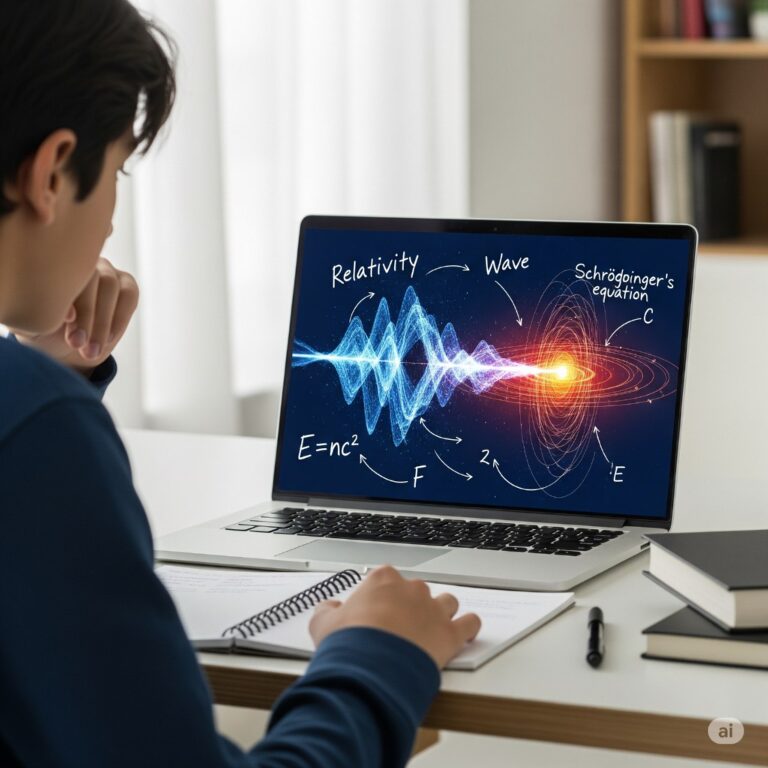
Physics in the 11th grade is the final chord in the school course, the time for systematization and generalization of all the acquired knowledge about the incredible world of physics. We will return to the already familiar sections, but consider them on a qualitatively new level, focusing on the relationshipcommunication between various physical phenomena and their practical application in the modern world. Particular attention will be paid to oscillations and waves, optics, the basics of relativity and quantum physics.
This year is a great opportunity to fill the latest gaps in knowledge and finally see the integrity and logic of the physical picture of the world. We will not just repeat the formulas, but learn to see a deep meaning behind them, to understand how the fundamental laws underlie the technologies that surround us. Successful mastering of 11th grade physics course will be your solid foundation for further education and understanding of the world around.
Approximate planning for the 11th grade physics course
Section and electrodynamics Part 1. ConstantElectric current | ||
| 1 | Electric current | |
| 2 | Serial and parallel connection of conductors. Shunts and additional supports | |
| 3 | Work and power of electric current. Joule-Lenz’s law | |
| 4 | Solving problems | |
| 5 | Electromotive force. Ohm’s law for a complete circle | |
| 6 | Electric current in metals | |
| 7 | Electric current in electrolytes. Electrolysis | |
| 8 | Electric current in gases | |
| 9 | Electric current in vacuum. Electrovacuum devices | |
| 10 | Electric current in semiconductors | |
Section I. Electrodynamics Part 2.Electromagnetism | ||
| 11 | Magnetic field | |
| 12 | Ampere force | |
| 13 | Lorenz’s power | |
| 14 | Faraday’s experiments. The law of electromagnetic induction | |
| 15 | Self-induction. Inductance. Magnetic field energy | |
| 16 | Magnetic properties of substances. Dia-, para- and ferromagnets | |
| 17 | Electromagnetic field | |
| Section II Electromagnetic oscillations and waves | ||
| 18 | oscillations. Types of oscillations. Physical quantities that characterize oscillations | |
| 19 | Free electromagnetic oscillations in an ideal oscillating circuit. Thomson’s formula | |
| 20 | alternating current. AC generators | |
| 21 | Active, capacitive and inductive resistance in AC circuit | |
| 22 | Production, transmission and use of alternating current energy. Transformer | |
| 23 | Electromagnetic waves. Properties of electromagnetic waves. Hertz’s experiments | |
| 24 | Principles of radiotelephone communication. Radio and television | |
| Section III. Optics | ||
| 25 | reflection of light. Laws of light reflection | |
| 26 | Refraction of light. Laws of refraction of light | |
| 27 | Complete reflection of light | |
| 28 | Lenses. Building images in lenses | |
| 29 | The formula of a thin lens | |
| 30 | Optical systems. angle of view | |
| 31 | Dispersion of light. Spectroscope | |
| 32 | Light interference | |
| 33 | light diffraction | |
| 34 | Planck’s formula. Light quanta | |
| 35 | Photo effect. Laws of the photoeffect | |
| Section IV. Atomic and Nuclear Physics | ||
| 36 | Rutherford’s experiment. Bohr’s postulates. Energy levels of the atom | |
| 37 | Types of spectra. Fundamentals of spectral analysis | |
| 38 | Quantum-optical generators (lasers) | |
| 39 | Proton-neutron model of the atomic nucleus. Nuclear forces. The binding energy of atomic nuclei | |
| 40 | Radioactivity. Basic law of radioactive decay | |
| 41 | Obtaining and using radionuclides. Methods of registration of ionizing radiation | |
| 42 | The nuclear fission reaction of uranium nuclei. thermonuclear reactions | |
| 43 | Elementary particles | |


 095 917 1785
 095 917 1785
 095 917 1785